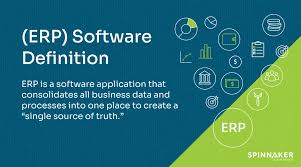
As businesses grow, operations become more complex. Managing finance, inventory, human resources, sales, and supply chains using separate systems or spreadsheets can quickly lead to inefficiencies, data errors, and poor decision-making. This is where Enterprise Resource Planning (ERP) software plays a critical role.
ERP software integrates core business processes into a single unified system, enabling companies to streamline operations and scale efficiently. Below are the top benefits of implementing ERP software for growing businesses.
1. Centralized Data and Improved Visibility
One of the biggest advantages of ERP software is data centralization. Instead of storing information in separate systems across departments, ERP consolidates everything into one platform.
This provides:
Real-time access to accurate data
Improved transparency across departments
Better collaboration between teams
Managers can make faster and more informed decisions because they have a complete view of the company’s performance.
2. Increased Operational Efficiency
Growing businesses often struggle with manual processes and repetitive tasks. ERP systems automate workflows such as:
Invoice processing
Payroll management
Inventory tracking
Order processing
Automation reduces human error, saves time, and increases productivity. Employees can focus on strategic activities instead of administrative tasks.
3. Better Financial Management
Financial control becomes more challenging as a business expands. ERP software provides integrated accounting features that help companies:
Track revenue and expenses
Generate financial reports instantly
Manage budgets effectively
Ensure tax compliance
With accurate financial data in real time, business leaders can monitor profitability and maintain healthy cash flow.
4. Scalability for Business Growth
A major benefit of ERP software is scalability. As your company grows—whether by expanding product lines, opening new locations, or entering new markets—the ERP system can adapt.
Modern ERP solutions such as SAP and Oracle offer flexible modules that allow businesses to add new features as needed. This ensures that the system supports long-term growth without requiring a complete replacement.
5. Improved Customer Service
Customer expectations increase as markets become more competitive. ERP software enhances customer service by:
Providing complete customer history
Tracking orders in real time
Improving delivery accuracy
Reducing response time
Sales and customer service teams can access up-to-date information, resulting in faster issue resolution and higher customer satisfaction.
6. Enhanced Inventory and Supply Chain Management
For growing businesses, managing inventory efficiently is critical. ERP systems help by:
Monitoring stock levels in real time
Forecasting demand accurately
Reducing overstock and stockouts
Improving supplier coordination
This leads to optimized inventory costs and smoother supply chain operations.
7. Stronger Data Security and Compliance
As companies grow, data security becomes increasingly important. ERP systems provide:
Role-based access control
Data encryption
Audit trails
Regulatory compliance support
Centralized data management reduces the risk of data breaches and ensures better governance.
8. Better Reporting and Business Intelligence
ERP software includes advanced reporting and analytics tools. Business owners can generate dashboards and performance reports instantly.
This enables:
Data-driven decision-making
KPI monitoring
Trend analysis
Performance forecasting
With accurate insights, companies can identify opportunities and address problems before they escalate.
9. Cost Savings Over Time
Although ERP implementation requires an initial investment, it reduces long-term operational costs by:
Eliminating redundant systems
Reducing manual labor
Minimizing costly errors
Improving resource allocation
The return on investment (ROI) becomes clear as efficiency and productivity increase.
10. Competitive Advantage
Growing businesses need tools that allow them to compete with larger enterprises. ERP software levels the playing field by providing structured processes, accurate data, and scalable systems.
Companies that leverage ERP can respond faster to market changes, optimize operations, and deliver better customer experiences.