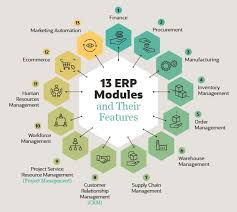
In today’s fast-paced business environment, efficient inventory and warehouse management are critical to maintaining profitability and customer satisfaction. Companies that struggle with stock inaccuracies, delayed shipments, or poor warehouse coordination often face higher operational costs and lost sales opportunities. This is where Enterprise Resource Planning (ERP) software plays a transformative role.
ERP systems integrate inventory, warehouse, procurement, sales, and finance into a unified platform, enabling businesses to gain full visibility and control over their supply chain operations.
1. Real-Time Inventory Visibility
One of the biggest advantages of ERP software is real-time inventory tracking. Traditional systems often rely on manual updates or disconnected spreadsheets, leading to discrepancies between actual and recorded stock levels.
With modern ERP platforms such as SAP solutions, Oracle ERP, and Microsoft Dynamics 365, businesses can:
Monitor stock levels across multiple warehouses
Track goods in transit
Automatically update inventory after sales or purchases
Reduce stockouts and overstock situations
Real-time data allows managers to make faster and more accurate decisions.
2. Improved Warehouse Organization
ERP software enhances warehouse layout and operational efficiency through structured location management. It enables businesses to:
Assign bin locations
Optimize picking routes
Manage batch and serial numbers
Implement barcode or RFID integration
By automating warehouse processes, ERP reduces human error and increases picking and packing speed. This leads to faster order fulfillment and improved customer satisfaction.
3. Automated Replenishment and Demand Forecasting
Modern ERP systems leverage historical sales data and analytics to forecast demand more accurately. Intelligent forecasting tools help businesses:
Maintain optimal safety stock levels
Automate purchase order creation
Prevent excess inventory accumulation
Improve supplier coordination
When integrated with procurement modules, ERP ensures that replenishment happens at the right time, reducing carrying costs while maintaining availability.
4. Enhanced Order Management
ERP connects inventory directly with sales and distribution processes. Once a sales order is created, the system:
Checks product availability
Reserves stock automatically
Updates inventory in real time
Generates shipping documentation
This seamless integration eliminates manual coordination between departments and reduces processing time.
5. Better Traceability and Compliance
For industries such as manufacturing, pharmaceuticals, and food distribution, traceability is essential. ERP systems enable full tracking of products from purchase to delivery through:
Lot and batch tracking
Serial number management
Expiration date monitoring
Quality control documentation
This improves compliance with industry regulations and makes product recalls faster and more precise.
6. Cost Reduction and Operational Efficiency
Inventory mismanagement often results in hidden costs such as:
Excess storage expenses
Dead stock
Emergency shipping
Manual labor inefficiencies
ERP software minimizes these risks by automating workflows and providing actionable insights through dashboards and reports. Businesses gain visibility into turnover rates, slow-moving items, and warehouse performance metrics.
7. Multi-Warehouse and Global Management
For growing companies operating in multiple locations, ERP provides centralized control over distributed warehouses. Managers can compare performance across sites, transfer stock between warehouses efficiently, and maintain standardized processes across regions.
Cloud-based ERP systems also enable remote access, allowing managers to monitor operations anytime and anywhere.